In our time, political speech and writing are largely the defence of the indefensible.
George Orwell, ‘Politics and the English Language’, Horizon, April 1946
Language is critical to the problems we now face in the relations between the governors and the governed, the problems that have spawned mistrust and contempt, and that have led so may to turn to extremes of right and left where language is differently dishonest but ever more brutal and still untested by reality.
White Papers and departmental strategies are written so vaguely that, if anyone later remembers them at all, there is enough verbal latitude to excuse their failures to deliver results. Political interviews are mere performance, verbal fencing in which questions are sidestepped and challenges parried, so that nothing is said for which government can be held accountable. Behind a veil of transparency, Parliamentary statements disguise past errors and avoid future commitments.
In all this, language is used principally to protect rulers from the legitimate demands—real or perceived—of those they rule but it is not new as George Orwell observed decades ago:
This mixture of vagueness and sheer incompetence is the most marked characteristic of modern English prose, and especially of any kind of political writing. As soon as certain topics are raised, the concrete melts into the abstract and no one seems able to think of turns of speech that are not hackneyed: prose consists less and less of words chosen for the sake of their meaning, and more and more of phrases tacked together like the sections of a prefabricated hen-house.
George Orwell, ‘Politics and the English Language’, Horizon, April 1946
One example of this obfuscation is the way the poor have become the disadvantaged, as if a decent life were a form of privilege. The chart below shows Google’s calculation of the frequency of use of the word ‘poor’ since 1800:
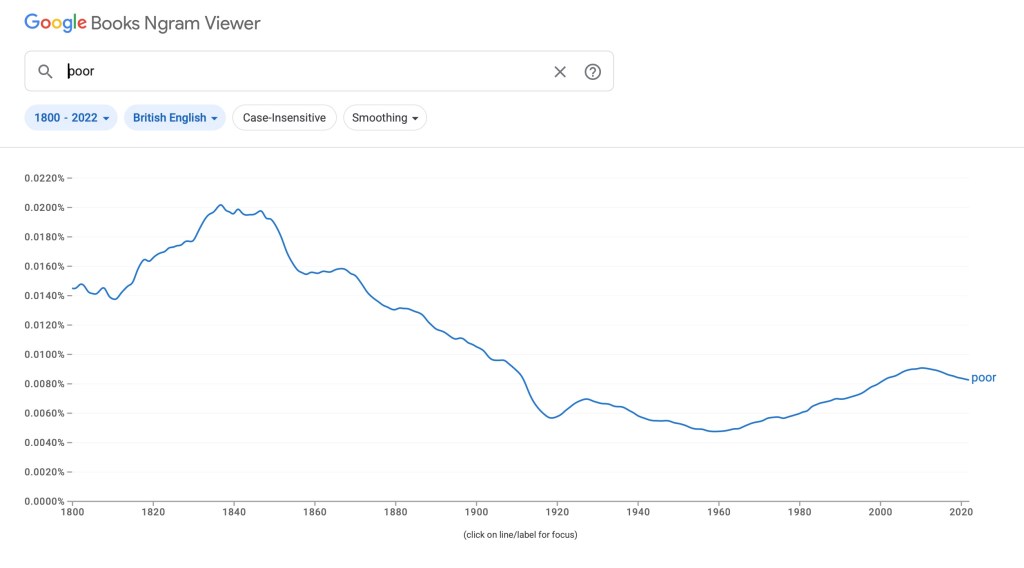
Now there are a number of possible reasons for this fluctuation, including the varying concerns of society and the political classes, but whatever the explanation, the decline in the frequency of use is clear. It is also clear to me that, over the course of my working life, terms like ‘poor’, ‘poverty’, ‘people’s rights’, ‘homelessness’, ‘union’, among many others, have become increasingly rare in political discourse and thus in the media and in everyday conversation.
But poverty exists and it is not disadvantage. Without the benefit of a sociological definition, I would say that poverty begins when a person’s whole income goes to cover their weekly costs and that they have no reserves to meet unforeseen events. Sadly, there are many who can only aspire to balance their weekly income and outgoings. To say it again, this is not disadvantage: it is poverty to a degree that imposes anxiety, illness and mental distress. It prevents people from living a decent life. And it is hidden by a political language which talks only of welfare bills and disadvantage, disability and worklessness. Poverty is neglected by politicians who have long since abandoned any real sense of responsibility to change social conditions or shame at the conditions in which so many of their fellow citizens live.
At the end of Orwell’s essay, he offers some famous rules for keeping writing honest:
Never use a metaphor, simile or other figure of speech which you are used to seeing in print.
Never use a long word where a short one will do.
If it is possible to cut a word out, always cut it out.
Never use the passive where you can use the active.
Never use a foreign phrase, a scientific word or a jargon word if you can think of an everyday English equivalent.
Break any of these rules sooner than say anything outright barbarous.
George Orwell, ‘Politics and the English Language’, Horizon, April 1946
They are good rules, and I keep them in mind (along with those of other good writers) when I work. I could sum them up as ‘say what you mean, as clearly and memorably as you can’. But they don’t solve the problem that Orwell identifies. Political speech has not become abstract and obscure by accident: the change is deliberate, designed to protect those who govern us from any form of genuine accountability. That corrupts the relationship between governors and governed and it must change, not least if honest co-creation is to be possible again.
 A Selfless Art
Leave a comment