I got home from the International Community Arts Festival in Rotterdam this evening, after five intense days of exposure to some current trends and practices across the world. As always, after such experiences, I have many impressions and mixed feelings. I’m not yet ready to organise or share my thoughts: they need to settle a bit before I can begin to see what they are and whether there is any pattern.
What I do know is that I found being there newly exhausting, physically and emotionally. I don’t know yet how much of that is in me, and how much in a festival that is naturally and happily evolving. ICAF only happens every three years. It was cancelled by the pandemic in 2020 and illness kept me away in 2023, so my last visit was in 2017—almost a decade ago. The world has changed greatly since then, and me with it. I need to reflect on what that means for both of us.
But I did have a wholly unexpected thought as I walked away from the Theatre Zuidplein for the last time on Sunday afternoon. Perhaps community art as I understand it is coming to an end.
I don’t mean that professional and non-professional artists will stop working together: that has happened for at least 200 years and some version of it is likely to exist in the societies and cultures that come after me. No, what I glimpsed was the possibility that the ideas, values, beliefs and practices that guided me and my generation may simply end with us, quite naturally, in the human cycle of renewal, because they don’t mean anything to a generation living in a time of social media, personal branding, democratic regression, racial division, Neo-fascism, chaotic war, Artificial Intelligence, and environmental disaster, to put the most obvious threats in broadly ascending order of danger.
I can see now that it was absurdly naive to see my field and its values as so universal that they would always be relevant, even if they take other shapes in different conditions. The truth is that our art will pass, just as every other artistic movement has done before. The best we can hope for – and it’s not nothing – is that someone might one day find something useful in what we did and thought.
And that is why writing it down is so important. Our art is especially ephemeral – moments of co-creation and rare performances, made with scraps, and ignored by the critics. We are those history forgets, because we are not its winners. So we must write our story, beliefs, insights and methods ourselves, like a message in a bottle cast into the waters or a time-capsule buried beneath in the wall so that those who come after will have something to find and think on.
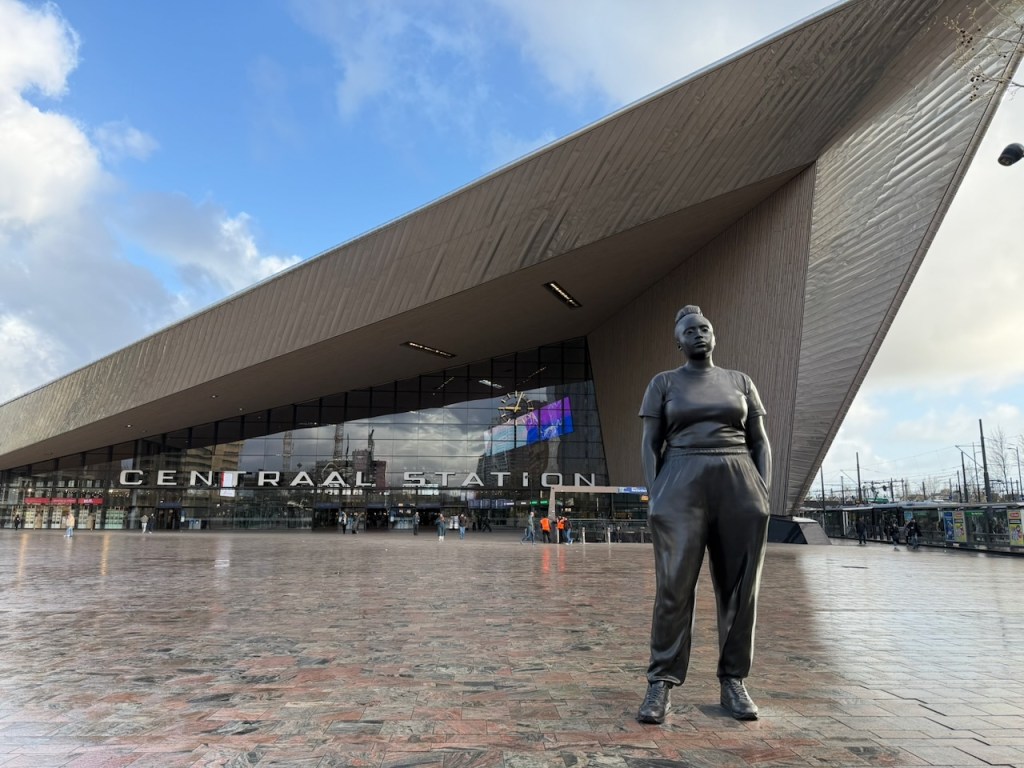
PS I admire the younger generation of community artists, even or perhaps most when they do things in very different ways to me. As I walked to the train station this morning, I liked this city that made a statue of a young woman, not a general or a politician or even a nymph, and I felt happy to be leaving the future of co-creation in her hands.
 A Selfless Art
Leave a comment